Cromwell invades Scotland
| < Oliver Cromwell | Δ Index | Stalemate in Scotland > |
Cromwell’s goal was to bring the three kingdoms – England, Ireland and Scotland – under his control. By 1650, he commanded England and Ireland through military force; a campaign in Scotland was intended to subdue the entire country.
When Charles – not yet King Charles II – landed in Speyside in June 1650, he intended to raise an army to march into England and restore his monarchy in all three kingdoms. He had the potential to unite Scottish anti-Cromwell feelings, and attract an army that would easily out-number Cromwell’s. But, although he was accepted by the Scots, in horror at the execution of his father, he was not their master.
In retaliation for Charles’s landing, Cromwell’s army invaded Scotland in July 1650. In Scotland, he was seen as a foreign invader rather than a British reformer. He had a well-disciplined, formidable army of 16,000 men, but one that would be overwhelmed if the Scottish factions could unite against him. English eyes watched his every step as he advanced into Scotland; he could not afford to lose any battles as this would risk upheaval in England.
Cromwell marched into Scotland along the east coast from Newcastle, supported by his navy, who captured the small port of Dunbar to create a forward supply base. The Scot’s army led by General Leslie, had fortified an area round Edinburgh and Leith to block his progress. As Cromwell approached, Leslie’s army conducted a scorched–earth policy as they withdrew to Edinburgh, to deny food and fodder to the invading force.
Ironically, when this policy forced Cromwell to fall back on Dunbar to re-supply, the Scots took this as a sign of retreat, and engaged in the disastrous battle of Dunbar in September 1650.
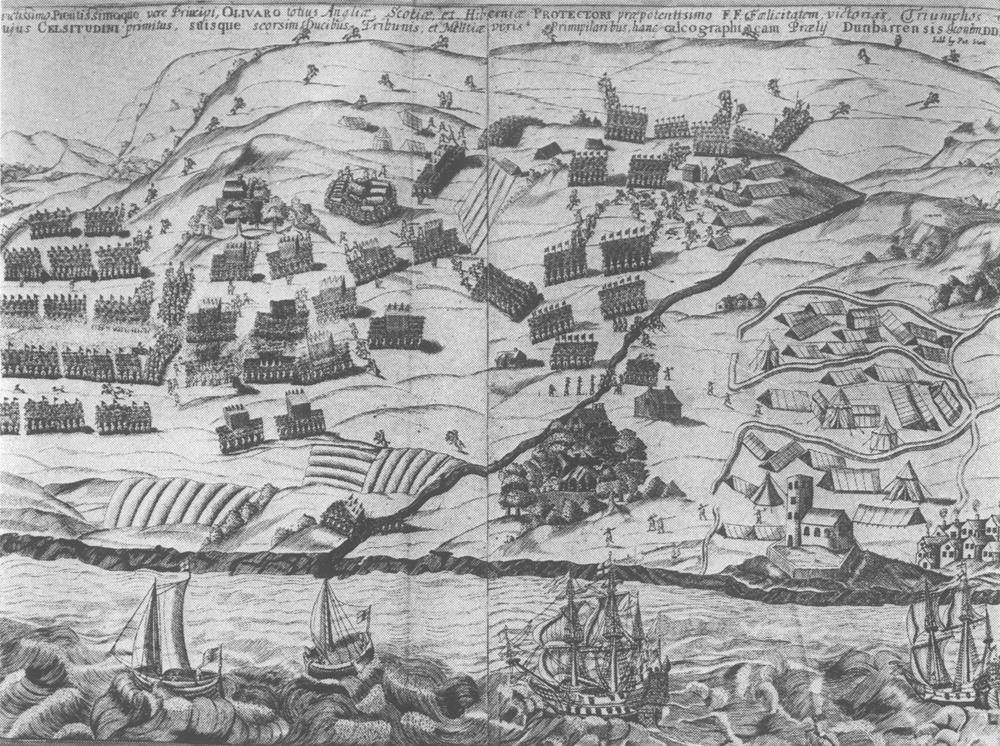
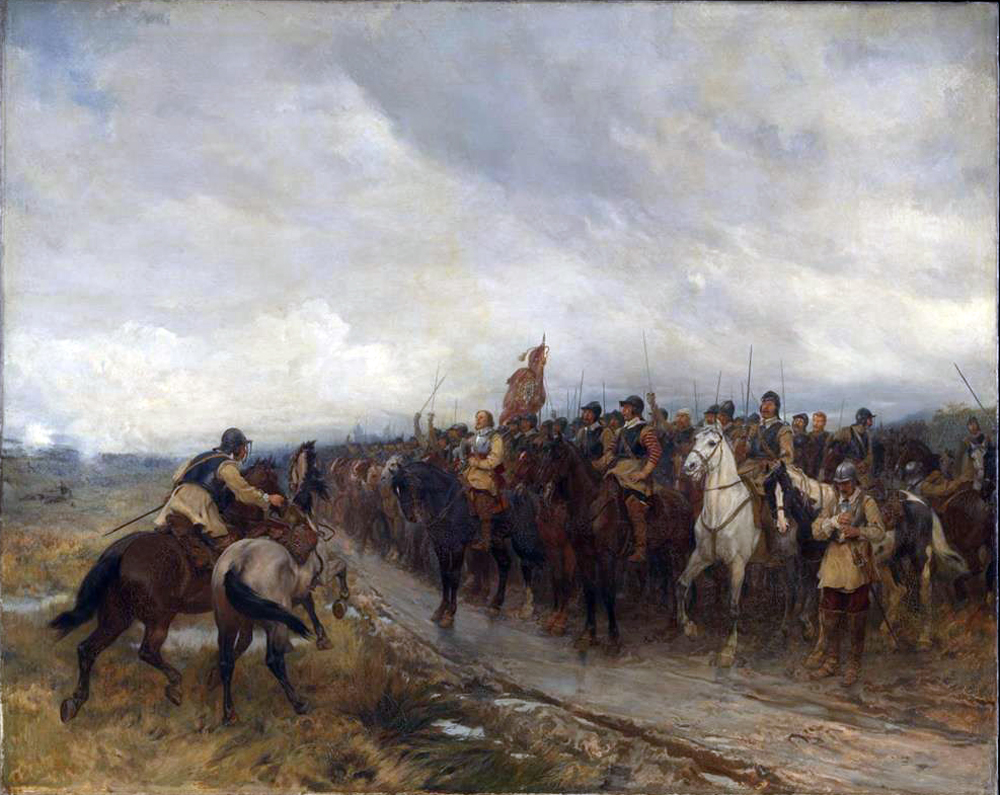 Cromwell at Dunbar – by Andrew Carrick Gow
The Scots lost over 4,000 men with 10,000 more captured. A mere 4,000 mostly cavalry, escaped.
Cromwell’s troops were all awarded the Battle of Dunbar medal, the first to be granted to all ranks of an army.
 The Battle of Dunbar Medal
After Dunbar the Scots’ army and parliament withdrew to a stronghold at Stirling, where they met up with Charles and his supporters. This gave Cromwell a degree of control over much of Scotland south of the River Forth, but it left the Forth as a formidable barrier to further progress.
The defeat at Dunbar made both sides realize that Cromwell could win any battle on open ground. Charles needed to break out and head for England, while avoiding a battle with Cromwell. Cromwell needed to draw out the Scot’s army from its stronghold. And so began a deadly game of hide and seek.
| < Oliver Cromwell | Δ Index | Stalemate in Scotland > |